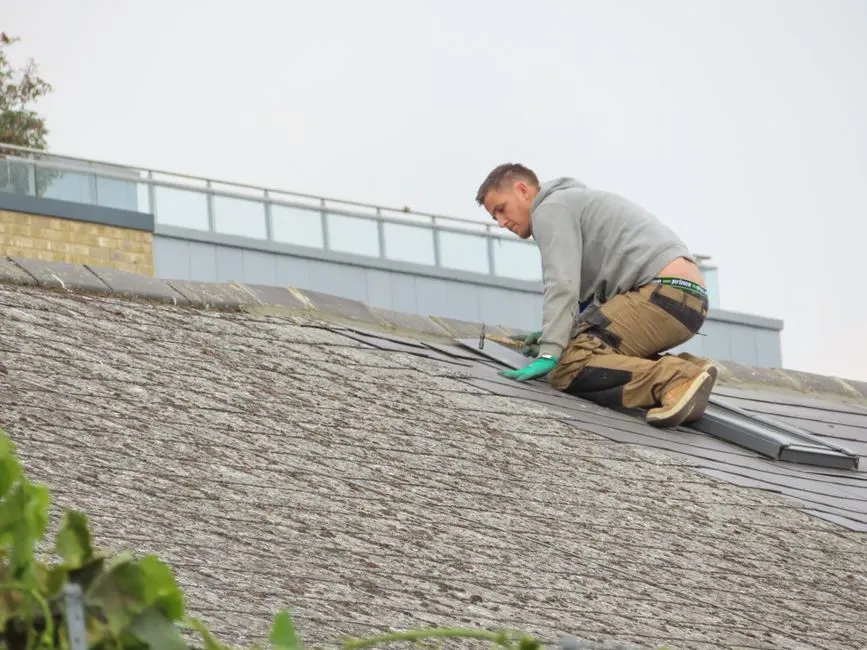
Water coming through your wall near the roofline means the flashing at a roof-to-wall junction, chimney, vent, or skylight has failed, and rain is running behind your siding or stucco instead of over it. The roof itself is often fine. The leak starts at a metal or membrane detail that has pulled loose, rusted through, or was never installed correctly in the first place.
We see this constantly in Altadena, where 1920s bungalows sit beside 1960s ranches and newer hillside builds, and every one of them has a different set of roof-to-wall details. This post walks through why the water shows up where it does, which flashing points fail first, what repair and sealing cost in 2026, and how to tell a five-minute fix from a job that needs a full flashing replacement.
Why water shows up at the wall near the roofline
Water entering at the roofline travels down inside the wall cavity before it ever shows on your interior paint. That is why the stain appears two or three feet below the actual leak, and why homeowners so often point us at the wrong spot on the first visit.
Flashing is the metal or membrane that bridges two surfaces water would otherwise run straight through: a roof plane meeting a vertical wall, a chimney passing through shingles, a vent pipe poking out of the deck. When that bridge is intact, water sheds over the joint and down the roof. When it is not, water follows gravity and capillary action into the gap, saturates the sheathing, and eventually finds a path through the drywall.
A few things make this worse on Altadena homes specifically:
- Age. Galvanized flashing from the 1940s through the 1970s rusts from the inside out. By the time you see the stain, the metal has usually been compromised for years.
- Heat cycling. Summer roof surface temperatures here push past 150°F, and winter nights drop into the 40s. That swing works sealant loose and opens seams.
- Wind-driven rain. Our winter storms push water sideways and upward, straight into joints that a straight-down rain would never reach.
- Roof replacements done cheap. When a roofer re-covers a roof without replacing the flashing, the old metal stays behind the new shingles and fails within a few seasons.
If you are seeing this for the first time after a storm, our team handles emergency roof flashing repair in Altadena, California and can usually stop active water the same day.
The flashing points that fail first on Altadena homes
Not every flashing detail fails at the same rate. In our experience across Altadena, San Gabriel foothill neighborhoods, and the older streets near the Arroyo, these are the six that cause the most wall leaks, roughly in order of frequency.
Wall flashing at roof-to-wall junctions
Where a sloped roof dies into a vertical wall, step or wall flashing has to be woven into the shingle courses and then counter-flashed into the wall itself. When the counter-flashing pulls away from the stucco or the step flashing was never properly lapped, water runs straight down the wall cavity. This is the single most common cause of water coming through a wall near the roofline that we diagnose.
Chimney flashing
Chimneys have four sides, and each one needs its own flashing detail plus a cricket on the uphill side if the chimney is wider than 30 inches. Masonry chimneys also move with heat and settle independently of the roof framing, which tears the flashing seal over time. If your leak tracks down beside the fireplace, chimney flashing is the first thing we check.
Vent pipe and skylight flashing
Every plumbing vent, furnace flue, and skylight is a hole in your roof. The rubber boot around a vent pipe cracks after 10 to 15 years of UV exposure, and skylight flashing relies on a curb that has to be perfectly sealed on all four sides. Both leak in patterns that look like a wall problem from inside.
Valley and step flashing
Roof valleys concentrate water flow. If the valley metal is undersized, rusted, or has debris packed into it, water backs up under the shingles and migrates sideways into the wall. Step flashing along dormers and sidewalls fails the same way when the laps are wrong.
Kickout and drip edge flashing
A kickout flashing is a small angled piece at the bottom of a roof-to-wall run that throws water away from the wall and into the gutter. When it is missing or was installed flat, water pours directly into the wall at the roofline. Drip edge protects the fascia and sheathing at the eaves, and when it is gone, water wicks backward into the wall assembly.
We replace and repair all of these details, and if you want the full picture of what we do, our roof flashing repair in Altadena, California page covers each type of flashing we work on.
Why is water coming through my wall near the roofline in Altadena, California?
Water comes through the wall near the roofline in Altadena because the flashing that should shed water over the roof-to-wall joint has failed, and the specific failure is usually tied to the age and construction of the house.
Altadena has an unusual housing mix. On the west side, you have 1920s and 1930s Craftsman bungalows with original wood siding, low-slope porch roofs, and masonry chimneys that have been repointed at least once. On the east side and up into the foothills, you have 1950s and 1960s ranches with stucco walls and composition shingle roofs that have been re-roofed two or three times. Newer hillside homes add complex roof geometry with multiple valleys and dormers.
Each of those profiles fails differently:
- Older wood-sided homes tend to leak at wall flashing and chimney flashing, because the original galvanized metal has rusted through and the siding has absorbed decades of moisture.
- Stucco homes leak at counter-flashing, because stucco cracks and pulls away from the metal, opening a gap that wind-driven rain exploits.
- Complex newer roofs leak at valleys and kickouts, where a small installation error creates a chronic problem.
Altitude and sun exposure matter too. Homes above 1,200 feet get more UV, more wind, and wider temperature swings than homes down in the flats, and their flashing ages faster. If you are searching for roof flashing leak detection in Altadena, California, the right first step is a proper inspection rather than another tube of caulk.
How we trace the leak before we touch anything
We do not start repairs until we know exactly where the water is entering. Guessing wastes your money and ours.
Here is the process we run on a typical Altadena wall leak:
- Interior inspection. We map the stain, check for moisture with a pin meter, and look at the framing direction to estimate where the water is coming from.
- Attic and crawl inspection. If there is an attic, we look for staining on the underside of the roof deck, wet insulation, and drip trails on rafters. That narrows the entry point to within a few feet.
- Exterior flashing inspection. On the roof, we check every flashing detail in the suspected zone: wall, chimney, vents, skylights, valleys, kickouts, and drip edge. We look for lifted metal, rust, missing fasteners, cracked sealant, and improper laps.
- Water test. When the source is still ambiguous, we run controlled water from a hose, one detail at a time, and watch for the leak to appear inside. This is the most reliable way to confirm the exact entry point.
- Written scope. You get a clear explanation of what failed, what we will replace, and what it costs before we start.
Most wall leaks we diagnose in Altadena trace back to one or two flashing details, not the whole roof. That is good news for your budget.
What water coming through wall repair and sealing costs in Altadena
Typical 2026 pricing for water coming through wall repair in Altadena runs $350 to $900 for a single flashing detail, and $1,200 to $3,500 when multiple details or a full flashing replacement is needed.
Here is how that breaks down by job type:
- Resealing a single failed joint (counter-flashing, vent boot, small wall detail): $350–$650.
- Replacing step or wall flashing on one wall run: $600–$1,200.
- Chimney flashing rebuild, including new metal and counter-flashing: $900–$2,200.
- Skylight flashing replacement: $700–$1,600.
- Full roof flashing replacement on a typical Altadena home: $1,800–$4,500 depending on roof size and complexity.
- Emergency after-hours response during a storm: add $150–$400 for the call-out.
Two things drive the price up more than anything else: access (steep roofs, tile, or tight hillside lots) and whether the leak has already damaged sheathing or framing. If we open up a wall and find rotted framing, that is a separate repair, and we will tell you before we do it.
If you need a roof flashing sealing in Altadena, California as a preventive measure rather than a repair, that typically runs $250–$600 for a full roof perimeter and detail seal.
What to watch out for
Most of the expensive wall-leak repairs we do are the result of a cheap fix that made the problem worse. Here is what to avoid.
- Caulk as a cure. Smearing roof cement or silicone over a failed flashing detail traps water behind it. The metal keeps rusting, the wood keeps rotting, and the leak comes back bigger next season.
- Re-roofing without new flashing. If a roofer quotes you a re-roof and does not include new flashing, walk away. Reusing old flashing is the number one reason new roofs leak at the walls.
- Patching the interior first. Painting over a water stain before the source is fixed hides the evidence you need to find the leak.
- Ignoring a small stain. A dime-sized stain in October is often a two-foot section of rotted sheathing by February. Water damage compounds.
- Hiring without a leak test. If a contractor wants to start replacing flashing without confirming the entry point, you are paying for guesswork.
One more: be skeptical of anyone who tells you the whole roof needs replacing when the leak is at one flashing detail. We replace roofs when they need it, and we fix flashing when that is the actual problem.
When to call a professional
Call a professional the moment you see water actively coming through the wall, smell musty odors near the roofline, or notice paint bubbling or peeling on an upper wall. Those are signs the leak has been running for a while.
You can safely handle a few things yourself: clearing debris from a valley, checking that gutters are not overflowing, and taking photos of any visible flashing damage from the ground. Everything else, especially anything that requires getting on the roof, should be handled by someone with the right equipment and insurance.
At Hometown Roof Protectors, we specialize in roof flashing repair in Altadena. We inspect, we test, we fix the actual entry point, and we test again before we leave. No guesswork, no upselling a roof you do not need.
Frequently Asked Questions
How much does water coming through wall repair cost in Altadena CA?
Most single-detail flashing repairs in Altadena run $350 to $900 in 2026. Multi-detail repairs and full flashing replacements range from $1,200 to $4,500. Emergency after-hours calls add $150 to $400. The final price depends on roof access, material, and whether water has damaged sheathing or framing.
Why is water coming through my wall near the roofline in Altadena, California?
It is almost always failed flashing at a roof-to-wall junction, chimney, vent, skylight, or valley. Altadena's older homes have rusted galvanized flashing, and stucco homes often have counter-flashing that has pulled away. Wind-driven winter rain pushes water into those gaps and down inside the wall.
Can you fix water coming through wall in Altadena?
Yes. We locate the entry point with an interior inspection, attic check, and controlled water test, then repair or replace the failed flashing detail. Most repairs are completed in a single visit, and we re-test before we leave to confirm the leak is stopped.
Do you offer water coming through wall fix near me in Altadena?
We serve all of Altadena and the surrounding foothill neighborhoods. If you are searching for a water coming through wall fix near me in Altadena, call us and we will schedule an inspection, usually within one to two business days and same-day during active storms.
Will insurance cover water coming through my wall?
Homeowners insurance typically covers sudden storm damage to flashing but not long-term deterioration or rot. Document the damage with photos before any repair, and we can provide a written scope you can submit with your claim.
Get help with Roof Flashing Repair in Altadena
If water is coming through your wall near the roofline, the leak will not stop on its own, and every storm makes the damage worse. Call Hometown Roof Protectors at 012345678 and we will find the entry point, fix the flashing, and confirm the leak is sealed before we leave.